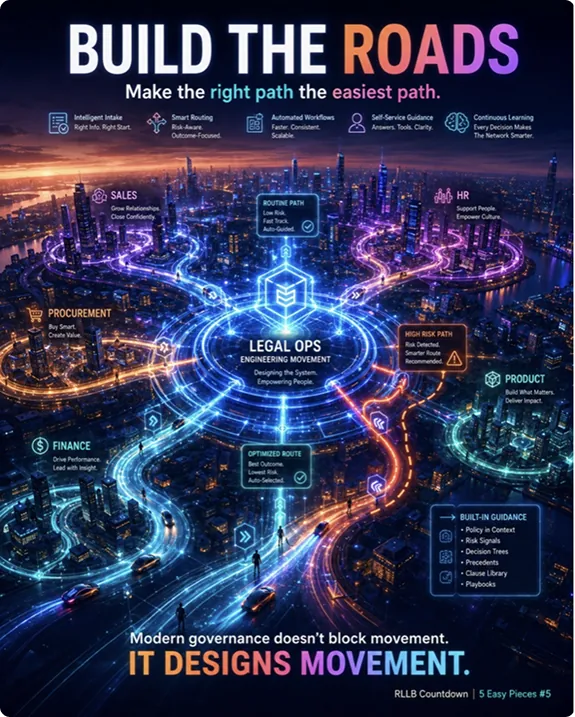
The Rise of LegalOps: From Support Function to Transformation Engine

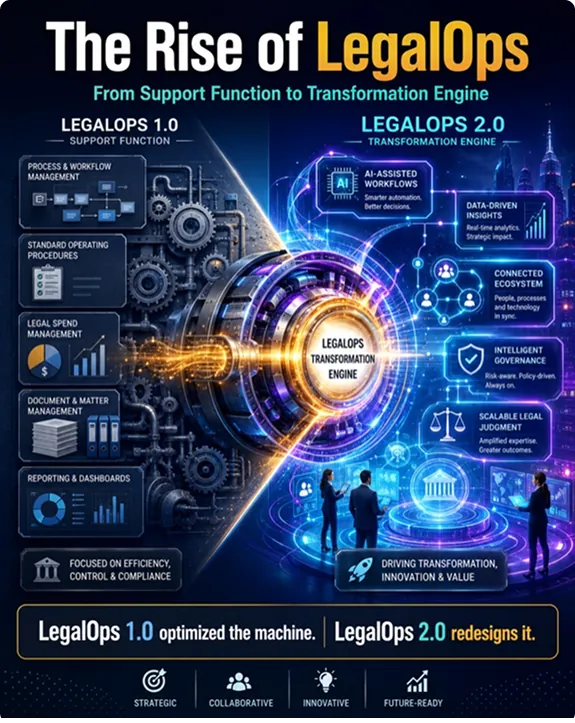
Twenty years ago, Legal Operations wasn't a profession. There was no defined career path. No established community. No blueprint for success.
In 2015, only 21% of legal departments had a dedicated LegalOps professional. By 2021, that number had nearly tripled to 61%. Today, more than 80% of legal departments have dedicated LegalOps resources. Roles that didn't exist a generation ago now command executive-level influence and compensation. Today, LegalOps is possibly the most strategically important function in the corporate legal ecosystem.
For the last decade, LegalOps optimized the machine through improved workflows, spend rationalization, process management. But what happens when optimization is no longer the biggest opportunity?
I believe we're entering a fundamentally different era. We're moving from a world where legal departments focus primarily on managing work to a world where they must redesign how work gets done.
How does legal judgment scale across an enterprise? How do human and digital workers collaborate? How do we move governance from a control mechanism to an enabling infrastructure?
These aren't technology questions. They're operating model questions.
And that's precisely why LegalOps matters. LegalOps already owns many of the capabilities required to build the next generation legal department.
Over the next five posts, I'll explore what that means and why the next chapter for LegalOps can be even more important and impactful than the last.
LegalOps 1.0 made the machine run better.
LegalOps 2.0 will redesign the machine entirely.
Part 1: Why LegalOps Was Built for This Moment
Twenty years ago, LegalOps emerged because legal departments had a problem that lawyers were not good at solving. As more legal work was being insourced, managing the portfolio became more complex. LegalOps brought process discipline, analytics, and technology into an environment that historically had very little of any of those things. And LegalOps as a discipline flourished.
Today, we're facing another -- even larger -- transformational moment. In building the Legal Departments of 2030, AI is the visible catalyst, but AI is not the story. The story is that we must fundamentally rethink how legal work gets delivered.
I believe that rethink starts by testing this basic premise: why do we organize legal department work around matters and not around products?
Matter based work: A question comes in. A lawyer answers it. Another question comes in. A lawyer answers that one too. We manage matters reactively and repetitively. It does not scale easily, evidenced by a whole industry of “matter management” solutions designed to serve law departments. But I believe that no matter how good your matter management platform may be, it masks rather than solves the basic premise.
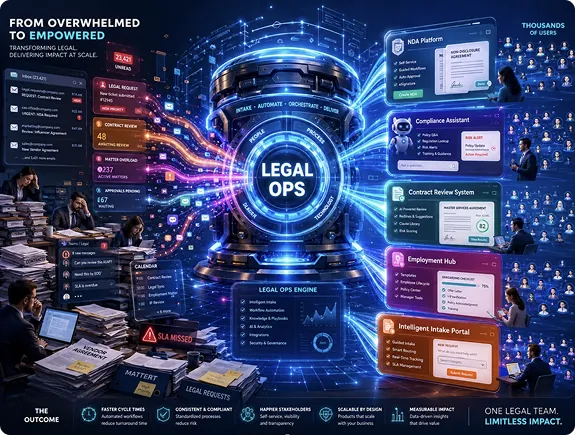
I believe world-class legal departments will solve the problem by thinking less about matters and more about products. An NDA process is a product. A self-service policy agent is a product. A contract review workflow is a product. A compliance guidance tool is a product.
The objective is no longer handling more requests; it is handling fewer. The objective is eliminating unnecessary or duplicative requests through intelligent design.
Just as we lawyers were not financial analysts, technologists, or procurement experts – leading to the advent LegalOps -- we are not product developers or product managers either. That may be the single biggest greenfield opportunity for LegalOps.
Let’s talk about that at RLLB next week.
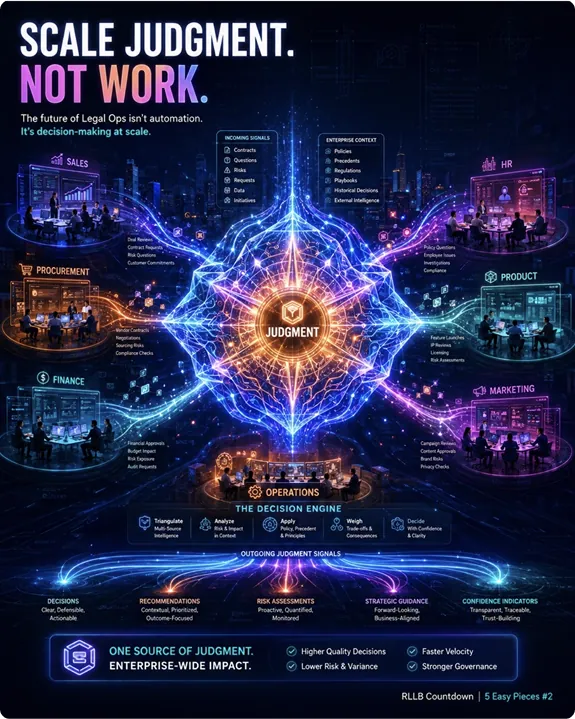
Part 2: Scale Judgment, Not Work: Why LegalOps Was Built for This Moment
Which AI tools are you using? What vendors are you evaluating? How many pilots do you have underway? Those are interesting questions. But they're not the most important question we must answer to build the Legal Department of 2030.
The most important question is this: what are we trying to scale?
Most people would say capacity, being able to handle more work with fewer resources.
I disagree. I think the answer is this: I am trying to scale judgment.
Legal departments don't create value because they produce templates and playbooks. They create value because they help organizations make decisions under uncertainty: act or wait? negotiate or walk away? litigate or settle? accept the risk or mitigate it?
The departments that have the biggest business impact over the next decade won't necessarily have the most technology, the biggest budgets, or the most people. They'll have the ability to scale high-quality legal judgment across the enterprise.
That is Judgment Maturity. AI maturity asks whether you have the tools. Judgment maturity – a higher order goal -- asks whether your organization can consistently make better decisions, faster, and at scale.
That's where LegalOps becomes central, because judgment scales through data, workflows, analytics, and operating models. These are things LegalOps already owns.
The destination isn't automation. The destination is organizational judgment operating at scale.
AI maturity is a feature. Judgment maturity is a strategy.
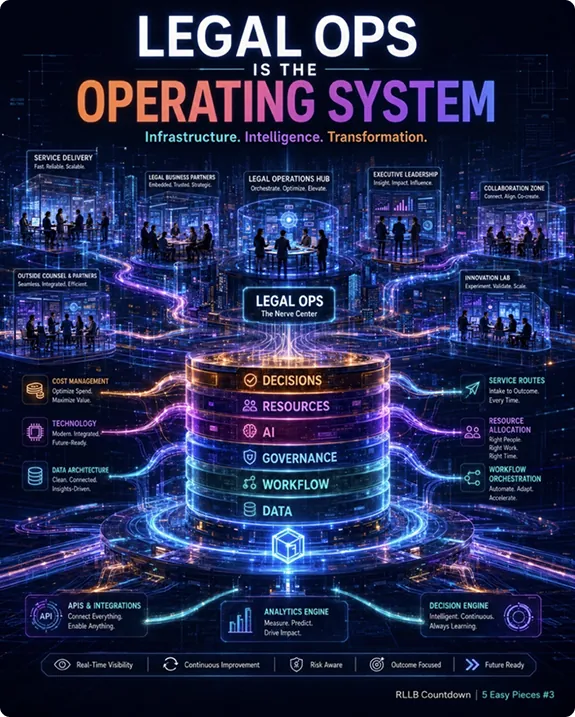
Part 3: Become the Operating System: Why LegalOps Was Built for This Moment
For years we've described LegalOps through a list of functions: spend management, vendor management, technology, reporting, project management. I’ve often described DXC’s LegalOps leader as our department CFO, CIO, and COO.
These are all important – very important -- but increasingly incomplete when it comes to building the Legal Department of 2030. There is a better analogy.
LegalOps is becoming the Operating System of the legal department.
An operating system doesn't perform the work. It enables the work. It governs how information flows, how resources are allocated, how users interact, how performance is measured, and how new capabilities are introduced.
Many legal departments today have a buggy OS: disconnected systems, manual workarounds, institutional knowledge trapped inside individual people. Too much process debt, technical debt, and people debt.
The opportunity for LegalOps is not simply to manage that environment. The opportunity is to redesign it.
As DXC’s CFO, CIO, and COO, LegalOps helps us manage cost, technology, data, workflows, execution, and change. And as we become more AI-enabled, those skills become more important, not less.
The next generation of LegalOps leaders won't just run operations. They'll design an operating system.
Let’s talk about that next week at RLLB.
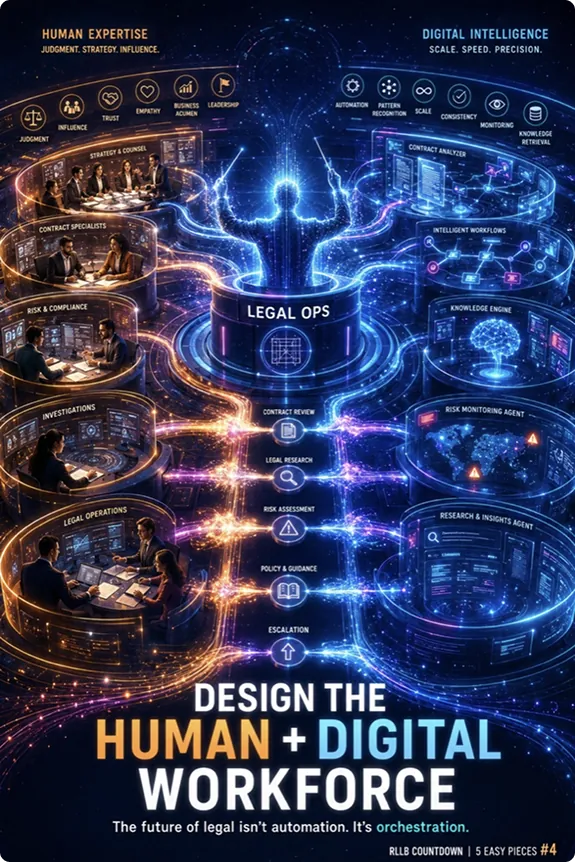
Part 4: Design the Human + Digital Workforce: Why LegalOps Was Built for This Moment
Every discussion about AI eventually becomes a discussion about jobs. That is an important issue, and the consequences are significant. But I also think that's too narrow a lens.
The more important discussion is workforce architecture. Every legal department is building or acquiring a new type of workforce. The Legal Department of 2030 will feature digital workers, AI agents, automated processes, decision-support systems, real time information flows.
The question isn't whether humans or machines will do the work. The question is how should they best work together? Somebody has to decide what gets automated, what remains human, where judgment resides, when escalation occurs, how quality is measured, and how risk is managed.
Those aren't technology questions. They're operational questions. They're LegalOps questions.
There's a thorny issue embedded here. Historically, lawyers developed judgment through repetition (research, drafting, negotiations). Once that work is automated, it eliminates the single most critical feedback loop for developing judgment: learning from mistakes made in all those reps. It creates a fascinating challenge. The greatest risk may not be that AI replaces lawyers. The greatest risk may be that AI replaces the experiences used to develop lawyers.
Future legal departments will need to design new pathways for building judgment skills. And because LegalOps increasingly designs the department operating system, LegalOps has the opportunity to design how future lawyers are developed.
Technology changes the work. Leadership decides what happens to the people. That distinction matters.
Part 5: Build the Roads: Why LegalOps Was Built for This Moment
Many organizations still approach governance as a control mechanism: policies, approvals, committees, delegations and escalations. The underlying assumption is that legal's job is to stop bad behavior.
I think that's the wrong model. The business is going to move, self-serve, and turn to AI if it thinks we are too slow. The question is not how to stop that behavior. It is whether legal helps guide that movement or tilts at windmills with fresh policies and restrictions.
For the Legal Department of 2030, the future of governance isn't building more guardrails. It's building roads that are safe, intuitive, and fast. Self-service tools are roads. Embedded guidance is a road. Automated workflows are roads. Risk-based triage is a road.
The best legal departments won't force compliance because they won't have to. They'll make the desired path the easiest path.
And that's really the bigger story behind this entire series.
LegalOps 1.0 was about optimizing the machine: spend management, technology management, vendor management, process improvement.
LegalOps 2.0 is about redesigning the machine: judgment, data, AI, productized services, workforce design, transformation.
The Legal Department of 2030 won't be discovered. It will be engineered. And LegalOps is uniquely positioned to build it.
See you at RLLB.